Publisher: Interplay
Developer: Silicon & Synapse
Release Date: November 1991
RPM Racing is a somewhat obscure early SNES racer most easily compared to the popular NES game R.C. Pro Am. Based on the 1985 Commodore 64 title Racing Destruction Set, it was the first game ever developed by Blizzard, which at the time was known as Silicon & Synapse. It was also the first American-developed SNES game.
RPM is a fairly basic isometric-view racing game. You choose from three cars and may upgrade them in a shop area between races. Mines, nitro, and oil slicks may be purchased and used as well. There are over 100 tracks, with some variety as to surfaces, such as pavement, dirt, and ice. The basic goal is to finish first in each race to earn money for car upgrades and for purchasing entry to more lucrative races and competitive classes. Also included are a track editor and a two-player mode.
Technically, RPM Racing is most notable for being one of a handful of games to use the Super Nintendo's high-resolution graphics mode, and the only one to use it exclusively in-game. This allowed for sharper, more detailed visuals, but sacrificed color, as the Super NES could only show 16 colors in that mode. It altogether made for a very bland-looking game compared to other titles of the SNES launch period which featured stunning(at the time) 256-color graphics.
A sequel to RPM Racing was developed and eventually released as Rock N Roll Racing in 1993. The latter game did not use the high-resolution mode, and featured far more color and personality, along with licensed music tracks, and was distinctly more popular than its predecessor.
Produced by: Catapult Entertainment
Release Date: November 1994
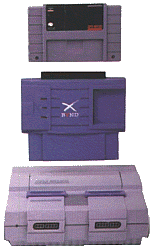
XBAND was an interesting device made by a company called Catapult Entertainment operating out of Cupertino, CA. It basically allowed you to play a handful of popular SNES games and chat over a dial-up connection with other human players. Even though it had a limited reach, many people consider it the forerunner of today's online console services.
I purchased one of these beauties for $19.95 at Blockbuster Video, which was pushing them hard at the time(1995). The service operated from from late 1994 through early 1997, and besides the price of the modem, you paid Catapult $4.95 a month for a limited number of connections to their network, or you could break the bank at $9.95 and go for unlimited connections. The extra five dollars was worth it for any serious gamer.
Generally you played only against other people in your area code, as long-distance fees were required otherwise. Because of this there would often be a considerable wait until someone with your game connected to the network, particularly if you were playing a game few people had like Doom. If you lived in a rural area, sometimes there would be no players available at all. I only knew of one other kid personally who had an XBAND, but there was a core group of local players who you could usually count on to be active most nights. A sense of community would develop among this core, which would quickly ostracize anyone who developed a reputation for "cheesy" play or for "pulling" from games, the latter of which was a frequent problem that was never adequately addressed by Catapult.
Besides gaming, the service also offered limited email functionality-- in fact my first email address was via an X-Band modem, as my family didn't own a computer at the time. Also there were a couple of daily newsletters which were mostly filler, but which didn't necessarily feel that way when you were a kid. Tournaments and rankings existed as well, but I was never good enough to do very well with those.
The complete list of games compatible with the device was:
Doom
Ken Griffey Jr. Presents Major League Baseball
Kirby's Avalanche
Killer Instinct
Madden NFL 95
Madden NFL 96
Mortal Kombat II
Mortal Kombat 3
NBA Jam TE
NHL 95
NHL 96
Super Mario Kart
Super Street Fighter II
WeaponLord
As you can see, the biggest problem with the service was compatibility. The only games that were developed specifically with the XBAND in mind were Namco's fighting game WeaponLord and Midway's SNES adaptation of Doom. Of the two, WeaponLord was the only one that had XBAND compatibility advertised on the box. The remainder of the compatible games were reverse-engineered by Catapult to work with the device. Even worse, the list above was not even the lineup of games available from the beginning-- the original slate was even more modest, and popular games like Super Mario Kart and Kirby's Avalanche were not playable until much later in the device's life.
XBAND died in early 1997, a victim of the internet boom and the passing of the 16-bit era, and Catapult faded from the limelight shortly thereafter. My time with the service had long passed by then. The games I had played primarily were Killer Instinct, which a lot of people had, and Doom, which virtually no one had-- so I mostly just played Killer Instinct. Unfortunately I was not a big fighting or sports game fan, and eventually tired of the service.
I still remember the local network of players though, and the interesting life revelations of a kid in middle school playing and chatting with people often a lot older than he was. XBAND was my first exposure to concepts like online play, chatting, and e-mail, and even though I only used the service for a relatively short time, it will always be remembered as a special part of my childhood.
Publisher: Accolade
Developer: Solid State
Release Date: May 1993
This franchise gets a lot of hate in retrospect, mostly because of the 3D sequel that was later released for the Playstation, but the original game was actually not so bad.
While it seems ridiculous now, Bubsy was one of the more hyped 3rd party games of 1993. It appeared in the midst of the "animals with attitude" craze initiated by Sonic the Hedgehog, and was a dyed-in-the-wool imitation, from the smart-aleck main character, to the open, multi-tiered level designs, to the game's pacing and physics. In fact Bubsy was regarded by some onlookers at the time as potentially being the Super Nintendo's answer to Sonic. Though it was later released for Genesis as well, the SNES version came out first because of an Accolade lawsuit with Sega at the time.
I bought into the hype completely and remember purchasing Bubsy as summer vacation began in 1993. Though I was disappointed that it was not quite as fast as Sonic, I wasn't displeased altogether. Bubsy is definitely in the upper echelon of 16-bit platformers. Though it doesn't do anything groundbreaking, the levels are huge and challenging, with lots of items to collect, and the graphics and sound are above average for the period. Bubsy was certainly hefty for a platformer of that era, weighing in at 16 megabits, and was packed with colorful animations and the sound samples of famed voice actor Rob Paulsen to give the Bubsy Bobcat character life. Since at the time the only other games of that size were usually fighting game conversions like Street Fighter II, notice was attracted for that fact alone.
Bubsy generally received positive reviews and was successful enough to merit a disappointing sequel released a year later. Accolade, which had re-branded itself upon Bubsy's launch as offering "Games With Personality," obviously had big things planned and intended the series as a flagship for the company. A cartoon pilot was actually made, a special edition was produced for Windows PC, and a next-generation sequel was licensed for the Atari Jaguar. Poor follow-ups however ultimately doomed the franchise to obscurity as the 32-bit era dawned, but it will always be infamous for the failings of its final installment, Bubsy 3D.